

The Painting Collection
Matthäus hated the Sunday family outings to Kyburg Castle. Having recently turned eight, he preferred to spend his free time with his best friend, a colt his father had bought him after a successful business deal. His father had achieved wealth early through shrewd financial transactions and his stakes in Winterthur's flourishing textile industry. He had secured his respected status in high society by marrying the only daughter of an influential aristocratic business partner. That year, 1870, the family had moved into a stately home in the north of Winterthur. For several years, the city had been one of the wealthiest in the canton of Zurich.
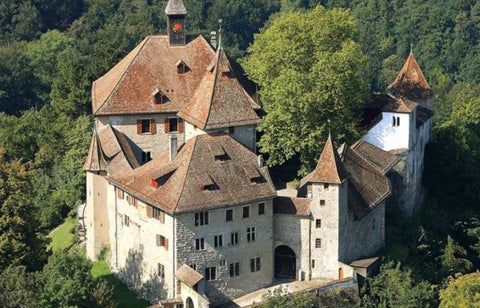
Kyburg Castle had been bought in the 1860s by Matthäus’ father’s best friend and his godfather, after whom he was named. At that time, First Lieutenant Matthäus Pfau had resigned as a city councilor of Winterthur due to his failing health and had fulfilled a dream by purchasing the castle. The younger Matthäus was very fond of his godfather because he entertained him with exciting stories from his travels in the Middle East as a young man. But ever since Matthäus Pfau had bought the castle and established a painting collection there, he had become peculiar. Shortly after the purchase, he began to tell his godchild gruesome stories about the counts and bailiffs who had once ruled the castle. At first, the boy had been enthusiastic, but after a while, his godfather always told the same story. It was about a boy who had previously lived in the castle and had disappeared under mysterious circumstances. Matthäus became increasingly bored in his godfather’s presence. One evening, he heard his mother tell his father that his friend was slowly going mad. She feared he would frighten Matthäus and his younger brother with his ghost stories. But his father reacted angrily, accusing her of always having spoken ill of his respected friend. The Sunday visits to the castle remained on the agenda.
One particularly gloomy Sunday, the family set off to visit their godfather. During the week, Kyburg was bustling with life, as Matthäus Pfau himself conducted tours of his painting collection. But on weekends, a bleak atmosphere settled over the deserted castle, intensified by the godfather’s increasingly strange behavior. Yet, the godfather insisted on receiving the family every Sunday at the castle for coffee and cake. The father gladly complied with this request; for the rest of the family, the visit became an unwelcome obligation.
When Matthäus and his family arrived at the castle that Sunday, the dreary, gray walls alone weighed on their mood. The godfather’s mood was just as dismal, as his wife had been traveling for a long time and kept postponing her return week after week. The lord of the castle led his visitors to the salon. While the men discussed business matters and the godfather slowly brightened up, the children ate cake and drank hot chocolate, occasionally reminded by their mother to mind their manners. Matthäus grew restless from sitting for so long and began to fidget in his chair, while his younger brother’s eyes drooped. His mother gave Matthäus a stern look, telling him to behave, and lifted the sleeping child into her arms. The godfather nodded to her, indicating she should put the boy in the nursery next door. Matthäus seized the opportunity and slipped away. He was eager to look at the painting that had been piquing his curiosity for some time.
The godfather had told him the gruesome story of the rider depicted on a pitch-black stallion. In the Middle Ages, this rider had ruled Kyburg as a count and treated his subjects atrociously. He imposed high taxes on them, forcing them to live in bitter poverty, while he squandered money lavishly on campaigns against rival castle lords and on his extravagant feasts. Eventually, the subjects attempted to storm the castle, but their plan was betrayed, and the count cruelly avenged himself. The leaders of the uprising were captured and tortured to death in the castle dungeon. He forced the survivors into even harder forced labor. In those terrible times, hardly any newborn child survived due to lack of food. When another child died in the midwife's hands, she was overcome with terrible anger and cursed the count's family. The count's young wife subsequently became pregnant several times and gave birth to healthy children. But every boy born died before he was four years old. When the count was once again embroiled in a months-long war with his neighbors, he received news on the battlefield that his three-year-old son was gravely ill. Driven by dark premonitions, he rushed on horseback to Kyburg, where his wife stood at the window with their son in her arms, desperately awaiting her husband. This moment had been immortalized by the unknown painter in the painting. The worried faces of the mother and the mortally ill boy were clearly visible in the picture.
The story had gone even further. Long after the count's family had died out, the curse still seemed to be active. It happened several times afterwards that a boy who had not yet reached his fourth year of life mysteriously disappeared from the castle. The people in the village whispered that the spirit of the countess, longing for a son, abducted young boys.
Matthäus loved to look at the painting and embellish the gruesome story in his imagination. He was so absorbed in the sight of the picture that he initially didn't hear his mother's excited loud shouts. Then his father appeared in the art gallery and grabbed him with a firm hand. "What nonsense have you been up to now? Where is your brother?" After a while, his mother had checked on his brother and found the crib empty. The little one was nowhere to be found. Upon hearing this news, the godfather had only sadly shaken his head and uttered confused words.
When the father realized that Matthäus was just as surprised by his brother's disappearance, he turned to his mother and spoke reassuringly to her: "We'll find him. He probably woke up and hid somewhere." As the parents hastily left the art gallery, a hot flush spread over Matthäus. He looked in horror at the painting, where his little brother could be seen in the countess’s arms in the castle window.
Written by: Manuela Klemenz
Comments (0)
There are no comments for this article. Be the first one to leave a message!