

The picture was gloomy. It showed a frightened woman in a dark room, like a dungeon, which receded into the blackness in the background. She looked pleadingly at the viewer. Fear and despair lay in her eyes. Her hands were stretched forward, as if touching an obstacle that neither the viewer nor she could see. Where was this woman? If it was a dungeon, she would be dirty and clothed in rags. Yet the woman in the picture was extraordinarily beautiful and well-groomed. Her blonde hair was artfully styled and pinned up. She wore an old-fashioned but elegant evening gown in a violet hue with black lace.
"Rosalia! There you are! We've been looking for you."
Rosalia flinched when she heard her name. She had been so absorbed in contemplating the picture that she had not paid attention to her surroundings. She looked around the room for the person who had called her. It was her cousin Alois. He hurried towards her. His flaming red hair could not hide their kinship. "What is keeping you from joining us?" he asked.
"The pictures. Haven't we traveled here to look at them?"
"Indeed. However, we finished the viewing some time ago. The host has invited us for a glass of wine. You must not miss it. What is keeping you for so long?"
"This picture. It fascinates me and frightens me at the same time."
"Terrible! So gloomy! Who paints such dreadful stuff!"
"If you will allow me, young sir, to introduce myself, my name is Théodore Mollet. And I fear you are looking at my work." The voice belonged to an old, frail man.
"You painted this picture?" Rosalia asked.
"So to speak."
"It fascinates me deeply. Am I allowed to ask questions about it?"
"Of course. It is always an honor to meet admirers."
Rosalia pointed to the picture and asked, "Who is the lady in the picture? Where is she and why is she afraid?"
The old man grinned, baring an unsightly set of teeth. "The picture is called <Trapped in the Mirror>. The woman in the painting was once a countess. Very beautiful, but only focused on her appearance. She was standing in front of a mirror when a sorcerer banished her into it."
"Why did he do that?" Rosalia asked.
"Because he could."
"How cruel. She looks so real. So alive."
"That's because she's still alive. She continues to live in the picture. If you look closely, you can see her blink."
Rosalia leaned forward and indeed, she believed she caught a slight movement. Startled, she recoiled and clapped her hands to her mouth in horror.
Mollet laughed loudly.
"That's enough!" Alois said and pulled Rosalia into his arms. "It's not kind to tell a lady such horror stories. Come, Rosalia, let's go to the others. You could use a little refreshment."
The old man bowed, still laughing, as Rosalia and Alois walked away.
That night, Rosalia barely slept. She kept thinking about the woman in the painting and what the old painter had said. Did he really just want to tell her a scary story to frighten her? She would have liked to learn more about this countess. Did she really exist? Was she still alive? Rosalia had barely dared to look in the mirror this evening, fearing the same fate might befall her. How ridiculous! She tried to calm herself with the words of the host, Lieutenant Colonel Pfau. Those were just spiteful words from a mediocre artist. She should rather look at those paintings depicting delightful landscapes and bouquets of flowers. With those, the risk of an encounter with the artist was low. Unless one met him later in the afterlife. The cognac and the words had calmed her for now, but since she was alone in this large room in the castle, just a few minutes' walk from that terrible picture, fear crept back into her limbs and deprived her of sleep.
The next morning, even before breakfast, Rosalia visited the painting in the gallery once more. Stubbornly, she sought a reason not to be afraid of it. She must have been mistaken when she perceived a movement. But before she could devote herself to contemplation, the painter Mollet greeted her. "Good morning, Mademoiselle. As I see, you are here again before this picture. I am sorry that I frightened you yesterday with my story. I myself do not know what came over me. Please dismiss it as the folly of an old man who only wanted to attract the attention of a delightful lady, such as yourself."
"You certainly succeeded," Rosalia replied coldly.
"Can you forgive me? How about an offer of peace? I will portray you."
"Like this woman?" Rosalia recoiled from him.
"Oh no, Mademoiselle, what are you thinking!" The painter shook his head vehemently. "A Mademoiselle like you, I would prefer to paint in nature. Leaning against a tree or in a flower meadow."
Rosalia looked thoughtfully at the painter. She already had portraits of herself, but none seemed to do her justice. The portrait of the countess is frightening, but the lady in the picture was impressively portrayed. Therefore, she replied: "I would like it in a flower meadow."
"Bon. Would this afternoon suit you? In the meadow in Loo?"
Her cousins would explore the surroundings on horseback in the afternoon. Instead of killing time with needlework, she could just as well have her portrait painted, Rosalia thought. "Very well. I will be there after lunch."
"It will be an honor. Au revoir." The old painter bowed and left.
Rosalia picked a few flowers and sat on the low stool in the flower meadow that Mollet had provided for her. The old painter draped her dress and instructed her: "Now please take a comfortable position that you can hold for a long time. For example, you could smell the flowers in your hand and look at me. Parfait! Please hold the position."
Rosalia loved being in nature. She enjoyed feeling the warmth of the sun on her, inhaling the scent of the meadow, and watching the busy activity of butterflies and bees.
At some point, she noticed that she was hearing fewer and fewer background noises. The rushing of the Töss faded. The buzzing of insects fell silent. Even the light breeze that made the grasses rustle had disappeared. Was Rosalia only imagining this silence because she had been in the same position for so long?
Carefully, she raised her gaze a little, looked around, and was startled. She did not recognize her surroundings. The forest that bordered the meadow was gone, as was the castle, the village, even every hill, mountain, and—the painter. She was alone in a meadow whose end she could not see.
A dead meadow, she realized. No living creature was in it anymore. Neither bee, nor butterfly, nor ant. Even the smell had left her. Wait, that wasn't true. The meadow smelled, but differently than usual. She plucked a blade of grass. It was damp and greasy. Incredulously, she looked at her fingers. They were green and smelled of oil paint. She screamed. But no sound came from her throat. She tried to get up, but she couldn't! This had to be a dream. She must have dozed off while modeling. Surely she would wake up soon.
Suddenly, the vault darkened and a huge face appeared above everything. It was a youth. But—she knew those eyes! They were the eyes of the old painter Mollet.
He spoke: "I did not tell you the whole truth when you asked why the sorcerer had imprisoned the woman. He does it to get her elixir of life. As you see, it worked once again. Your life force gave me back my youth. For this, you will eke out your future in this painting. Your world is limited to what I have painted. Now you can still move a little, but once the paint is dry, only minimal movements are possible. I will take your painting to the others in the castle gallery. It has turned out beautifully. What a shame that you can no longer see it as a whole. Au revoir, Mademoiselle."
Rosalia stretched her hands pleadingly towards the face, but it disappeared. She realized that she could no longer move her hands. Her skin had become brittle and taken on the texture of a canvas. She opened her mouth in a desperate, soundless scream and froze.
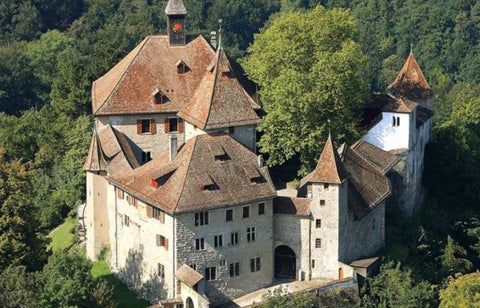
While Rosalia's name was called in and around Kyburg Castle that evening, the art museum was richer by one painting. It showed a young woman with flaming red hair in a richly blooming meadow. Her arms were stretched out towards the viewer. In her eyes, sheer terror was reflected.
The End
Written by: Gina Nicoletti
Comments (0)
There are no comments for this article. Be the first one to leave a message!