

Kyburg Castle between Worlds
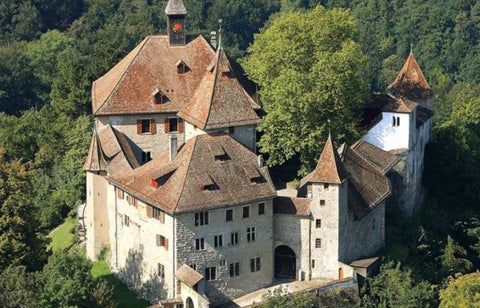
How Matthäus Pfau loves these evening strolls around and through his castle. He doesn't do it out of vanity, but with a puffed-up chest. And rightly so. The elaborate and costly renovation he initiated saved the medieval Kyburg Castle from probable decay and restored it to new splendour. But the real jewel is his magnificent collection of paintings, which has finally found a fitting home in the Knights' Hall and the other rooms of the palace.
One of his favourite works is the recently acquired painting "The Avalanche Cone in the Haslital" by Caspar Wolf. It complements his collection of nature and winter paintings, which also includes a work by William Turner and some by Gustave Courbet. But his favourite in this genre is Caspar Wolf. He loves his archaic depictions of raw, untamed nature. Even today, he can hardly get enough of it. In the background, these rugged rock faces and mountain peaks, towering into the sky against gloomy clouds, forming an imposing composition of rock, ice, and snow. And in the foreground, this mighty avalanche cone, these massive snow masses, interspersed with rocks and tree trunks broken like matchsticks.
But – Pfau falters. Has something moved in the painting? Shaking his head, he takes one step back, then another. He glances at the painting again, takes his pince-nez from his nose, breathes on the lenses from both sides and polishes them with the pocket square of his jacket. He puts the pince-nez back on and approaches the painting. To fathom the strange phenomenon, he gets so close that his nose almost touches the picture. Then a mighty, white-haired hand, a paw even, shoots out of the painting, grabs Pfau by the neck. He grips the paw with both hands, tries to scream, but only gurgles unheard and disappears into the painting.
In the district court of Oberhasli in Meiringen, Pfau fully regains consciousness. Frozen and soaked. His hair matted, his face and hands scratched by thorns and rocks, his jacket torn. One of the slippers he was wearing while walking through the castle was lost, the other is soaked with water. The descent from the remains of the avalanche cone, where he and his captor entered the Haslital, down into the valley was tough.
The five-judge court awaits Pfau. The Yeti nudges him onto the only free chair in the courtroom. The presiding judge is Muggestutz, one of the last Hasli dwarfs. To his left sit the mountain spirit Melchaa and one of the spirits from the Grimsel Pass. To the right of the presiding judge sits a Tatzelwurm, where the Yeti now also takes a seat. The owl Claucus acts as scribe. As prosecutor, the golden eagle Argutalix ruffles his feathers. Muggestutz nods to him.
Argutalix clears his throat with a croak and begins to speak:
"Esteemed Mr. Presiding Judge, Honourable Court, Accused. I will read the indictment in the criminal case of Matthäus Pfau for alleged violations against the world of spirits. Committed in the aftermath of the Sonderbund War of 1847."
He looks around – and continues:
"After it had ended mildly within a short time with the victory of the liberal and" – he snorts contemptuously – "so-called progressive cantons over the conservatives, the victors seemed not to entirely trust their own population. Whether they were as progressive in the rural and remote regions like the Haslital as one would like them to be in the cities? So, with troops from other cantons – so as not to provoke conflicts with their own population – they began purges against everything that could not be plausibly explained with the three senses.
This meant the de facto end for the spirit world in the Haslital. And this under the leadership of Lieutenant Colonel Matthäus Pfau, the commander of the troops marched up from the Zurich area. Melchaa, this majestic and graceful mountain spirit, managed to save herself by transforming into a mountain stream above Engstlenalp and henceforth flowing northward as such through formerly Catholic-conservative lands. Until she was appointed as one of the judges in this case. Or the Grimsel spirits, of whom only a few like Granitus" – he looks at the shadowy figure at the judge's bench – "survived the massacre of Handeck and have since dwelled in the crypts of the Gelmerhörner. Under conditions unworthy of spirits. No better fate befell the Yetis, who had to flee from the Rosenlaui Glacier to the distant 8000m peaks of the Himalayas. It ended disgracefully for the Tatzelwurms and the Hasli dwarfs. The former now eke out an existence as pastries in a Meiringen bakery to tantalise human palates, the Hasli dwarfs as cute goblins in children's books." For the prosecution, the elements of Nano- and Ethereal-genocide*) are clearly met. They request a commensurately severe penalty.
Muggestutz thanks him for his presentation and turns to Pfau:
"What do you say to these accusations?"
Pfau has visibly recovered.
"I will not comment on this farce," he says contemptuously. "Except that I merely did my duty as a soldier. That much. Without a lawyer, I will say nothing more."
"Your victims didn't have lawyers then either," Prosecutor Argutalix snaps back at him.
"Gentlemen, gentlemen," Muggestutz says to the antagonists, "please maintain your composure."
While a fierce dispute begins to unfold in the Meiringen administrative building, there is an alert at Kyburg Castle. The master of the house has disappeared. From one minute to the next. His wife Amelie cannot explain what happened in any way.
Aware of the missing person's prominence, Chief Hunter Herrmann Ziegler, as commander of the local gendarmerie post, personally, along with his assistant, rural policeman Wilhelm Vogelsang, mounted their horses and galloped straight to Kyburg. Shrugging their shoulders after the initial inspection, they have to explain to the weeping wife that the evidence is sparse and points little to a crime. Only a painting lying on the floor, with a tear in the canvas.
"And one of his favourite paintings at that," Amelie sighs, "inexplicable."
"And no, he is certainly not suicidal, that he would have done something to himself," she replies to Ziegler's awkward question.
Vogelsang scratches the back of his head. This tear in the canvas won't let him go. He bids farewell with a snappy salute.
It has been some time since he read about the so-called "world gates". Some "tunnels" through which it should be possible to establish connections between widely separated, perhaps even intertwined areas of the universe, and possibly even between different time periods. Well, the forest imp from the Sihlwald, whom the author cited as a reference, does not exactly enjoy the best reputation. But for Vogelsang, it is clear. This poor woman must be helped, even if it is by an eccentric forest imp.
Late at night, Vogelsang arrives in the Sihlwald.
"Of course," says the forest imp, "that sounds logical. Someone or something took the peacock to the Haslital, where a tragedy may now be unfolding." After a brief contemplation, he asks: "Your name is Vogelsang, isn't it?"
The rural policeman nods.
"That's wonderful," grins the forest imp. "In 2024, in about seven or eight generations, a Markus Wüthrich – but his mother is a Vogelsang, so you're somehow related – will be a pilot in the helicopter squadron stationed at Meiringen airfield."
"Pi-, Fli-, Heli-what?" Vogelsang stutters inquiringly?
"I can explain that to you another time," says the forest imp, "time is pressing. We can write a message to your relative and have one of my 'shadow birds' deliver it."
Rural policeman Vogelsang nods silently and pale.
Soon, a chillingly screeching bird flies away through the Sihlwald.
"Arise," Muggestutz says to Pfau: "In the name of the dwarfs and spirits of the Haslital, the following judgment is rendered. The accused Matthäus Pfau is found guilty of nano- and ethereal-genocide, committed in the period after the Sonderbund War of 1847, to the detriment of countless dwarfs, Tatzelwurms, Yetis, and mountain spirits. The penalty shall be determined by a divine judgment. By a fall into the Aare Gorge. Like many of the victims who perished in their flight over the Kirchet Pass. The judgment is legally binding and is to be executed immediately."
The small procession tramps reverently through the snow towards the Kirchet Pass. Ahead is Pfau, flanked by Muggestutz and Yeti. Behind them are the mountain spirit Melchaa, Granitus, and the Tatzelwurm. Argutalix and scribe Claucus bring up the rear. At the highest point, where the Aare rushes through the narrow gorge 100 meters below, Muggestutz asks Pfau to step to the edge and say a final prayer. Then, a roaring noise breaks the silence. An unprecedented monster of iron screams through the air. It grabs Pfau by the shoulders and disappears in the direction of the Brünig Pass.
"Alea iacta est," says Muggestutz.
"The die is cast," the others repeat in chorus, "the gods have spoken."
The monstrosity causes great excitement on its flight towards Winterthur. The Federal Council meets for a crisis meeting, the army, civil defence, and fire brigades are mobilised. Church bells ring everywhere, and people rush into churches and chapels. Fearing the end of the world, the "locust from the abyss" described in the Revelation of John seems to have appeared.
At Kyburg Castle, there is joy. Matthäus Pfau, much dishevelled but happy, climbs out of the landed helicopter and embraces his wife. Pilot Markus Wüthrich waves laughingly from the window: "Goodbye, I need to find my way back to the 21st century before I run out of kerosene. You probably can't help me with that."
Glossary
*) "Nano-cide": Derived from the Greek "νάνος"/"nanos" for dwarf;
"Ethereal-genocide": "αιθέριος"/"aithérios" for the immaterial/spiritual
and "cide" for killing.
This is based on the term "genocide" for systematic mass murders and the destruction of entire peoples.
Written by: Hans Peter Flückiger
Website: https://geschichten-gegen-langeweile.com
Comments (0)
There are no comments for this article. Be the first one to leave a message!