

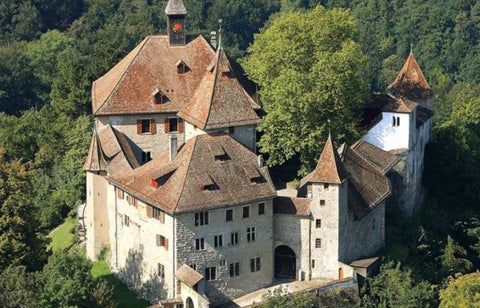
Commissioner Sebastian Stolz thought of a brewery horse. He followed the housekeeper through one of the long corridors of Kyburg Castle. As she lumbered snorting in front of him, her considerable backside swayed under the black fabric of her uniform.
Stolz was curious about Lieutenant Colonel Pfau. Various stories about the man circulated in the city. The widower had lived alone with his staff at Kyburg for six years. However, it was rumored that his wife was not buried, but very much alive on the Côte d'Azur with a wealthy Frenchman.
It was also said that Pfau had been thoroughly swindled when buying the castle. After the first thunderstorm, it also turned out that the entire roof had to be renovated. Since that episode, people had secretly called him General Jinx.
Even wilder stories than those about the Lieutenant Colonel revolved around his painting collection. It was said to house paintings by an unknown painter from the Balkans that would make one's blood run cold. According to rumors, the lord of the castle owed his wealth not only to a lavish inheritance but also to trading in these infamous paintings.
"Wait here!" said the housekeeper as they arrived at an elaborately decorated door, knocked briefly, and disappeared into the room. When she reappeared, she whispered, "The Lieutenant Colonel will see you shortly. He's busy for another moment. You may go in, but please wait by the door until he has time for you." As she curtsied, Stolz briefly wondered whether he should offer her a sugar cube in his open hand as a thank you. Smiling, he entered.
The room was a surprise. The walls of the hall had been stripped of plaster, and artfully framed paintings hung on long threads in front of the roughly hewn stone blocks of the masonry. Persian carpets covered the floor, and chandeliers hung from the ceiling. Apparently, after the overpriced purchase of the castle and the renovation of the roof, General Jinx had sufficient funds to have this hall decorated. As the commissioner entered, three people at the other end of the room turned to him. A man in uniform, probably the Lieutenant Colonel, and a couple, presumably married. He gave a brief nod of greeting and then turned away. Stolz was not an art connoisseur. He categorized paintings into "I like it" and "I don't like it." Thus, the picture next to the door, a sailboat, belonged to the first category, while the next painting, a gloomy oil painting of someone who had painted a plate of fruit, belonged to the second. He found it incomprehensible how anyone could spend money on such things.
The third painting depicted two children in a forest clearing. The green of the trees looked so real that Stolz almost thought he could hear the gentle rustling of the leaves. Through the treetops, the sun's rays fell like warm gold on the scene. The little boy knelt in the lush green grass, the girl with a bonnet stood behind him, her delicate hand on her brother's shoulder. Both turned their faces to the viewer. It was the expression of the children that truly took the commissioner's breath away. The fear in their small eyes, their lips widened in a scream, the girl's fingers clutching the boy's shirt.
"Do you like it?" Stolz spun around. He had been so lost in the painting that he hadn't heard the Lieutenant Colonel approach. The other visitors seemed to have left. The uniformed man smiled kindly and extended his hand. "Lieutenant Colonel Pfau." "Pleasure," Stolz had to clear his throat, "Commissioner Stolz, Winterthur City Police." Pfau's handshake was surprisingly weak. His graying hair was thinning, his eyes a pale blue. Only his waxed mustache with its twisted ends had something sharp about it. "And?" he asked.
Stolz raised his eyebrows questioningly. The lord of the castle smiled and pointed behind the commissioner. "The painting, do you like it?"
"Oh," he said. "No. I think it's terrible. It's..." He searched for words.
"Frightening?" Pfau asked, still smiling. "Yes, it is indeed terrifying, isn't it?" He looked at the painting. "The horror in the children's eyes in the face of imminent death. The viewer is immediately placed in the perpetrator's perspective, becoming the very horror that will soon befall the children. The discrepancy between harmony and terror gives the work incredible tension and political depth."
Stolz didn't engage in the silly art talk. He had no intention of buttering up General Jinx or being impressed by his pompous speech. "Is this one of the paintings by that fellow from the Balkans?" he asked.
"Hungary," the Lieutenant Colonel corrected him. "Incredible how this man manages to capture fear so realistically on canvas."
"Never mind." Stolz let his gaze wander over the paintings.
"Go ahead," Pfau gestured invitingly into the room. The commissioner hesitated. But then a macabre curiosity seized him, and he began to walk around. He quickly realized that the Hungarian's paintings always followed the same pattern. A harmonious, almost kitschy background in contrast to pain and mortal fear. A person freezing in a glittering snow landscape, a woman in a flower meadow staring at the sky with a face distorted by fear.
Lieutenant Colonel Pfau pointed to the latter and said he had just sold it. "And how much does such a... work cost?" Stolz tried to imbue his words with as much disdain as possible. The lord of the castle smiled smugly. "I'm afraid the amounts are likely to be beyond your pay grade."
The commissioner refrained from responding. Time to get down to business. "I don't assume you called me here for the sake of art, Lieutenant Colonel. What is it about?" Pfau had also stopped smiling. Soberly, he said, "I want to report a theft."
"What was stolen?" Stolz asked, pointing to the paintings. "One of those?"
"Money," said the uniformed man, "and Greta Fässler, my youngest housemaid, has also been missing for two days."
"How much was stolen? And where was it taken?"
The Lieutenant Colonel didn't bat an eyelid as he answered the commissioner.
He couldn't believe his ears. "Eighteen thousand francs? She stole eighteen thousand francs from your desk drawer? You keep that much money in your desk?"
Pfau remained calm. "A reserve for all eventualities. I don't trust bankers. All scoundrels. Moreover, it's not certain that Ms. Fässler actually took the money. Normally, I vouch for my employees. I pride myself on my judgment of character. Furthermore, both the study and the desk are always locked."
"The keys?"
General Jinx briefly looked down. "I'm afraid they're gone too."
"Like Greta Fässler."
"Like Greta Fässler."
There was a brief pause. Stolz couldn't believe it. Eighteen thousand francs in the desk drawer. How naive could one be? "We'll do what we can. If it was Ms. Fässler, there's a chance we'll find her and the money soon. May I see the study?"
While Lieutenant Colonel Pfau showed the commissioner his office, he continued to assert that, in his judgment of character, Ms. Fässler had not seemed like a thief. Stolz could not find any details relevant to solving the theft. He took his leave and announced that someone would come tomorrow to take statements from the staff.
The horse's backside was waiting for him at the exit with his things. Stolz took his hat, allowed himself to be helped into his coat, and walked to the waiting carriage. Before getting in, he looked up at the massive building one last time. Abandoned by his wife, swindled by his predecessor, and robbed by his maid. The commissioner shook his head. Excellent judgment of character, no question. He would issue a warrant for the woman and hand the case over to the State Criminal Police Office. Let them see to it that General Jinx got his money back. He had to admit that he even wished a little that Greta Fässler would succeed in escaping abroad with her loot and starting a new life.
Lieutenant Colonel Matthäus Pfau stood at the window of his study, watching the police officer's carriage drive away. Once again, he was proud of his ability to judge people. He lit a lantern and made his way to the cellar. This brave proletarian of a commissioner would half-heartedly deal with the theft, then let it fizzle out. The case would be filed and forgotten before the end of the year.
He unlocked an inconspicuous door and stepped into the dark room beyond. The lantern illuminated an easel with a canvas. As he lit the carbide lamps on the walls, the darkness gave way to a harsh working light, revealing a huge glass case. It was the size of a wardrobe and looked extremely massive. Greta Fässler sat, clad only in a nightgown, on the floor of the glass cage. Her faint whimpering could be heard through the holes in the lid of the case. The Lieutenant Colonel flipped a lever at the back of the room, went to the easel, grabbed a paintbrush, and looked at the idyllic lake on the canvas. "Well, then," he said as there was a brief gurgle and water began to flow into the glass case through a pipe in the ceiling.
Written by: Tobias Bonderer
Comments (2)
Bravo Manuela, bravo allen zusammen
Sehr spannend geschrieben. Die Kyburg hat bei mir allerdings massiv an Sympathie verloren. Brrrr…
Lieber Tobias
Deine Kurzgeschichte gefällt mir sehr gut. Freut mich zu sehen und zu lesen, wie Du am Schreiben dranbleibst. Ich wünsche Dir eine gute Vorweihnachtszeit und weiterhin viel Freude beim Schreiben.
Herzliche Grüsse, Reto