

Our new wild herbs collection is another passion project, created in loving collaboration with Julia and her workshop MellowApricotStudio.
Wild herbs have fascinated me for a long time – their diversity, their power, their silent beauty. My knowledge of them has been rather modest so far. All the more gratifying it was to immerse myself in this green world with Julia, discover new things, and bring our impressions to life in lovingly designed products.

My curiosity was piqued. Now I wanted to know more: what stories, old customs, facts, and mysterious myths lie behind each herb. I rummaged through various books, researched online, and discovered new things – and that's exactly what I'm going to share with you now!
Did you know that wild garlic has countless names? Some of them appear right here.
In spring, wild garlic is a must for me – how about you? Have you ever tried it? I regularly buy this flavorful herb at the market and love to use it in my dishes.
When the forests awaken in spring, a familiar scent often fills the air – spicy, slightly sharp, unmistakable: It's wild garlic season.
Also known as "Latschenknofel" or wild garlic, it is one of the most popular wild herbs of the season. Its characteristic garlic smell announces its presence from afar, especially in shady, damp spots along riverbanks or under the canopy of old trees.
Its bright green, oval leaves push through the foliage from March – delicately shiny on top, matte on the underside. They taste most intense raw, for example in pesto, herb butter, or as a spicy note in salads and smoothies.
Wild garlic also unfolds its power when cooked – as a delicate aroma in risotto, soups, or stuffed pasta. And anyone who has ever pickled its buds in oil or vinegar knows: wild garlic is not only healthy but also a real delicacy. From April onwards, its white flowers appear, star-shaped and delicate – perfect as an edible decoration on the plate.
But wild garlic can do more than just taste good: Rich in vitamin C, essential oils, minerals, and sulfur-containing allicin, it has detoxifying, metabolism-stimulating, antispasmodic, and antibacterial effects. No wonder it is considered a real health booster in spring cures – against spring fatigue, for gastrointestinal complaints, or for natural support of blood pressure and cholesterol.
The name "Bärlauch" (bear's garlic) probably goes back to old stories in which bears ate it after hibernation to regain strength. And so, to this day, it is attributed with vitalizing, cleansing power – almost like a gift of nature to us.
But caution is advised!
Wild garlic has dangerous look-alikes: Lily of the valley and autumn crocus look similar but are highly poisonous. A reliable distinguishing feature is the smell – because real wild garlic emits a distinct garlic aroma when rubbed. When in doubt: rather leave it and buy it at the market or grocery store.
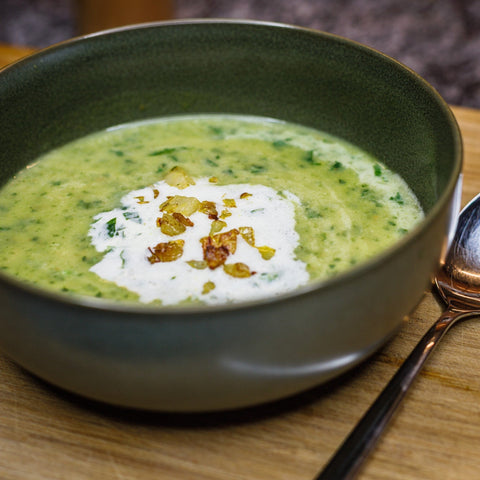
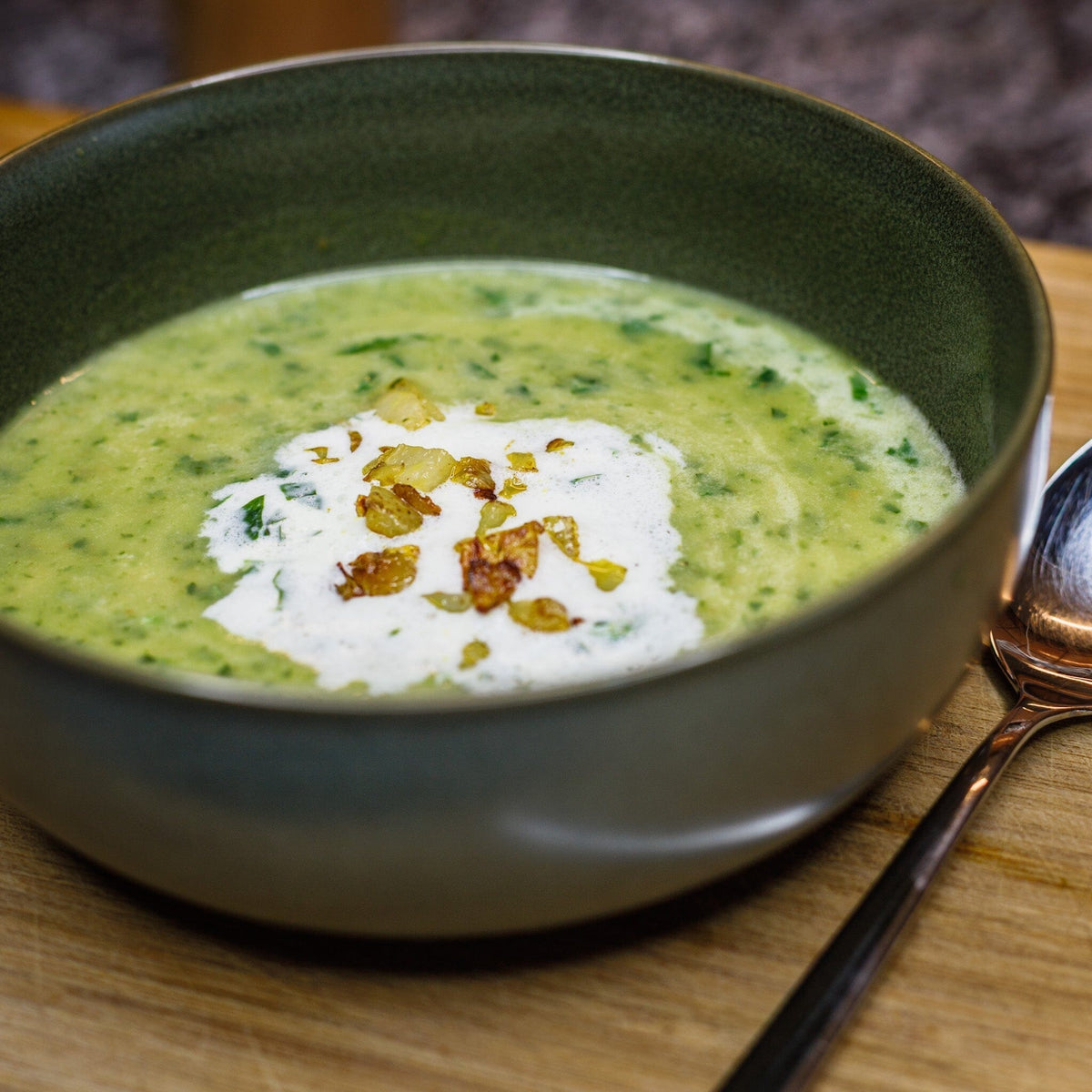
Wild Garlic Soup
Recipe for 4 people
Preparation time 35 min - vegetarian
- Onion
- 500 g potatoes
- 1 tbsp olive oil
-
9 dl vegetable broth
-
25g wild garlic leaves
-
1 tbsp olive oil
-
2dl half cream
-
25g wild garlic leaves
-
Salt, pepper to taste

How to proceed
- Peel the onion and chop it roughly. Also peel the potatoes and cut them into cubes of about 1.5 cm. Heat some olive oil in a pan. Sauté the onion, then briefly sauté the potato cubes.
- Add the broth and bring the soup to a boil. Then reduce the heat and simmer, covered, for about 10 minutes. Remove about 4 tablespoons of the potato cubes, drain them on kitchen paper and set aside. Cook the remaining potatoes for another 10 minutes until soft. Add the finely chopped wild garlic and puree the soup. Heat some oil in a coated frying pan and fry the reserved potato cubes until golden brown and crispy for about 10 minutes.
- Whip the cream lightly. Finely chop the remaining wild garlic and mix it into the cream. Stir half of this mixture into the soup, season with salt and pepper, and heat briefly without boiling. Serve the remaining wild garlic cream separately with the soup.
- Tip: Mix the cream with the finely chopped wild garlic about an hour before whipping – this allows the aroma to infuse better.
"When wild garlic sprouts, spring kisses the forest."
Let's wander back through the centuries and dive into the long, fragrant history of wild garlic – back to its origins.
Even in ancient times, people knew about the power of wild garlic. It was widespread in the Germanic world – as shown by old names like "Ramser" or "Rämsch," which are deeply rooted in Germanic and Old High German languages.
In ancient Rome, too, the aromatic herb was no stranger: The Greek physician Dioscorides and the Roman naturalist Pliny the Elder already mentioned it in their writings in the 1st century – a sign of how much wild garlic fascinated people even then.
In the 12th century, it finally found its way into monastic medicine. Hildegard von Bingen, visionary abbess and healer, described wild garlic as an effective remedy. And its reputation remained even later: The well-known medieval herbalist, Hieronymus Bock, even compared it to the highly esteemed garlic.
Notebooks, Stickers & Bookmarks
In the Middle Ages, wild garlic was far more than just a spicy herb – it was revered as an important medicinal plant and reverently called "Herba Salutaris," the herb of salvation. But its power was not only valued in medicine: it was also attributed with special effects in popular belief.
As the plant of the bear – that strong, mythical creature – it was considered a protective plant that could ward off evil spirits. This belief lived on particularly in old customs. For example, at the Thuringian Ramschelfest, an ancient ritual where people went out into the forests before Walpurgis Night to collect wild garlic – as protection and blessing for the coming time.
And if you're now curious about the mysterious night from April 30th to May 1st, which is still celebrated in many places with fires and old customs – then I have two exciting links for you here.
Wild Garlic Butter in Gugelhupf Shape
Recipe for 4 small Gugelhupf molds
Preparation time 15 min - vegetarian
- 150 g butter, soft / vegan butter
- 30 g wild garlic
- Fleur de sel
- Pepper from the mill
- Small Gugelhupf silicone mold (optionally also ice cube tray)

Here's how to do it
1. Whip the butter: Using a hand mixer, beat the soft butter for about 5 minutes until light and fluffy.
2. Prepare the wild garlic: If necessary, wash the wild garlic, pat it dry, and chop it finely.
3. Season: Add the wild garlic to the whipped butter. Season with fleur de sel and freshly ground pepper.
4. Shape: Fill a small Bundt cake or other silicone mold with the wild garlic butter and spread evenly. Tap lightly and press down to avoid air pockets.
5. Chill: Place the mold in the refrigerator and chill for at least 1 hour until the butter is firm.
6. Tip: The wild garlic butter tastes delicious with fresh bread, grilled vegetables or meat – and looks especially pretty on the table in a Bundt cake shape.
My book recommendation for you
I hope I could give you some new insights and exciting information about wild garlic today.
Perhaps you have already gained experience with this wild spring herb yourself – or are you now keen to try it out in your kitchen?
All the recipes you find here have been tried and tested by me – with great attention to detail and joy in experimentation. While cooking, stirring, and seasoning, not only delicious creations emerged, but also the photos you see in this post.
The atmospheric product photos of the notebooks, bookmarks, and stickers are by Julia Felber – MellowApricotStudio.
In the next blog post, we'll continue with an equally powerful plant: the dandelion. Look forward to interesting facts, tips, and inspiration from nature!
If you like, feel free to leave me a comment – I'm curious about your ideas, experiences, or favorite wild garlic recipes.

The author: Heike Felber
I am Heike Felber, the owner of Kreativ Werkstatt 24. I originally come from photography – the play with light, perspective, and moments has always fascinated me. Today, I work full-time in IT, but my heart belongs to creativity.
The workshop is my place to breathe, experiment, and create. Here I combine technology with craftsmanship, logic with intuition – and leave space for everything that arises from joy and passion. For me, creativity is not a hobby, but an attitude. And that's exactly what I want to share with others in the Kreativ Werkstatt.

Comments (0)
There are no comments for this article. Be the first one to leave a message!